When you buy a used car in the UAE, especially in Abu Dhabi, legal responsibility for any accident depends on one key factor: ownership status at the time of the accident. If the car is still registered under the seller’s name, the seller carries responsibility. However, once ownership transfers officially to the buyer through the traffic authority, the buyer becomes fully responsible for all legal and financial consequences.
Understanding this point matters because many buyers assume responsibility starts when they pay money. In reality, UAE law connects responsibility to registration, not payment or agreement. This difference often creates confusion, disputes, and unexpected liabilities for new car owners.
Car accident liability UAE and how responsibility is defined
In the UAE, car accident liability UAE rules depend on official vehicle registration records. The police and insurance companies always check the vehicle owner in the traffic system before assigning responsibility.
Therefore, if an accident happens before transfer of ownership:
-
The seller remains legally responsible
-
The seller’s insurance applies
-
The buyer has no legal liability
However, once the buyer completes the transfer:
-
The buyer becomes the legal owner
-
The buyer takes full responsibility for accidents
-
The buyer must ensure valid insurance coverage
This system protects both parties, but it also requires careful timing during the sale process.
Many people in Abu Dhabi ask whether signing an agreement makes them responsible. The answer is no. Only the official transfer at Abu Dhabi Police or vehicle licensing authority creates legal responsibility.
Buyer accident responsibility UAE before ownership transfer
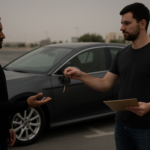
Before ownership transfer, buyer accident responsibility UAE law is very clear. The buyer is only a temporary custodian during inspection, test drive, or negotiation stage.
During this stage:
-
The seller keeps full legal responsibility
-
The seller’s insurance remains active
-
Any fines or accident reports go to the seller
Even if the buyer drives the car during a test drive and an accident happens, insurance usually covers it under the seller’s policy if permission was given.
However, complications may arise if:
-
The buyer drives without permission
-
The buyer violates traffic rules during test drive
-
The seller did not activate valid insurance
In such cases, liability may shift depending on police investigation findings.
This is why experts always recommend a clear test drive agreement before handing over keys.
Used car accident history UAE and hidden damage risk
One of the biggest concerns for buyers is used car accident history UAE transparency. Many buyers in Abu Dhabi ask how they can avoid cars that had serious accidents before purchase.
UAE law requires sellers to disclose major accident history in most cases, but enforcement can vary in private sales.
Common risks include:
-
Hidden frame damage
-
Undisclosed airbag deployment
-
Poor repair after total loss
-
Fake mileage after accident repair
If a buyer discovers hidden accident damage after purchase, responsibility becomes complicated. Legally:
-
If fraud is proven, the seller becomes liable
-
If no fraud is proven, the buyer carries the risk
-
Insurance may reject claims for pre-existing damage
This is why professional inspection before purchase is critical.
Car accident liability UAE after ownership transfer
Once the ownership officially transfers, car accident liability UAE rules shift completely to the buyer.
From this moment:
-
The buyer becomes the registered owner
-
All fines attach to the buyer
-
Insurance must be under buyer’s name
-
Accident responsibility belongs to the buyer
Even if the accident was caused by previous mechanical issues, the law still considers the registered owner responsible.
This surprises many new car buyers in Abu Dhabi. They often assume the seller remains responsible for old problems, but UAE traffic law does not work that way.
So, before completing transfer, buyers must ensure:
Buyer accident responsibility UAE during test drive
During test drives, buyer accident responsibility UAE depends on permission and insurance coverage.
If the seller allows the test drive:
-
Seller’s insurance usually covers damage
-
Buyer is not legally responsible
-
Police record still shows seller as owner
However, if the buyer acts recklessly:
-
Insurance may reject the claim
-
Buyer may become personally liable
-
Police may issue fines directly to driver
Many Abu Dhabi residents do not realize that traffic cameras and police reports focus on driver behavior, not just ownership.
Therefore, both parties must stay careful during test drives.
Used car inspection and accident liability protection
To avoid future disputes, buyers should always complete a proper inspection. This is one of the strongest protections in used car accident history UAE cases.
A proper inspection helps identify:
-
Previous accident repairs
-
Structural damage
-
Airbag replacement history
-
Suspension and chassis issues
Many buyers in Abu Dhabi also wonder if inspection reports are legally binding. While they are not always legally binding, they help prove whether the seller misrepresented the vehicle.
This becomes very important in fraud cases.
Car accident liability UAE and insurance responsibility
Insurance plays a major role in car accident liability UAE situations. In most cases, insurance determines how financial damage gets handled.
Key rules include:
-
Insurance follows the registered owner
-
Claims require valid policy at accident time
-
Driver must be authorized under policy
-
Some policies cover multiple drivers, others do not
Once ownership transfers:
-
Buyer must update or purchase new insurance immediately
-
Old policy usually cannot be used by new owner
-
Driving without insurance leads to heavy penalties
Many new buyers in Abu Dhabi delay insurance transfer, which creates legal risks if an accident happens during the gap.
Buyer accident responsibility UAE for financed vehicles
Financed cars create another layer of responsibility. In buyer accident responsibility UAE rules, banks also play a role.
If the car has a loan:
-
The bank holds legal ownership until full payment
-
Seller cannot transfer ownership without clearance
-
Buyer must ensure loan settlement before purchase
If an accident happens during financing period:
-
Insurance usually covers damage
-
Bank may require repairs before release
-
Outstanding loan remains active
Many buyers in Abu Dhabi ask whether they should avoid financed cars. The answer is no, but they must verify clearance properly before transfer.
Car accident liability UAE in private vs dealer sales
Responsibility also depends on where you buy the car.
In private sales:
In dealership sales:
-
Dealers often provide warranty or inspection reports
-
Legal protection is stronger
-
Accident history is more transparent
Therefore, car accident liability UAE risk is usually lower when buying from licensed dealers.
However, even dealers may not guarantee full accident protection unless explicitly stated.
Used car accident history UAE and fraud cases
Fraud cases are increasing in the used car market. Buyers often face issues related to hidden accident history.
Common fraud examples include:
-
Fake “no accident” claims
-
Tampered chassis numbers
-
Repainted vehicles sold as accident-free
-
Export-import history hiding major damage
In Abu Dhabi, authorities take fraud seriously. If proven:
-
Seller may face legal penalties
-
Buyer may claim compensation
-
Sale contract can be canceled in some cases
However, proving fraud requires documentation and inspection reports.
Buyer accident responsibility UAE and ownership timing mistakes
One of the most common mistakes happens during ownership transfer delays.
Some buyers:
During this gap:
-
Legal responsibility still belongs to seller
-
But financial disputes often arise
-
Insurance coverage may not apply properly
This gray area creates confusion in buyer accident responsibility UAE cases.
To avoid risk, transfer must happen immediately after payment.
Car accident liability UAE and police reporting system
The UAE police system plays a major role in determining accident responsibility.
When an accident happens:
-
Police record driver details
-
Vehicle ownership is checked in system
-
Fault determination is issued
-
Insurance claim is processed
This system removes confusion between buyer and seller once ownership is updated.
Many Abu Dhabi residents wonder if verbal agreements affect police decisions. The answer is no. Only official records matter.
Used car accident history UAE and resale value impact
Accident history affects not only safety but also resale value.
Cars with accident history:
-
Lose market value
-
Face insurance premium increases
-
Become harder to sell later
-
May require more maintenance
Therefore, buyers must think long-term before purchasing any vehicle with accident history.
Even minor accidents can affect value depending on repair quality.
Buyer accident responsibility UAE after resale
After resale, responsibility fully shifts to the new owner. However, legal disputes may still arise if the buyer claims hidden defects.
In such cases:
-
Courts examine inspection reports
-
Seller disclosure statements are reviewed
-
Insurance documents are checked
If misrepresentation is proven, responsibility can shift back to the seller even after transfer.
This is why documentation is extremely important in UAE car transactions.
Car accident liability UAE and Abu Dhabi traffic laws
Abu Dhabi traffic laws strictly enforce ownership-based liability. The system ensures accountability through registration records.
Key points include:
-
Vehicle registration defines legal owner
-
Insurance must match registration
-
Police reports determine fault
-
Fines attach to registered owner
This system keeps responsibility clear but also strict.
Used car accident history UAE and buyer protection steps
To protect yourself, always follow these steps:
-
Check vehicle history report
-
Inspect chassis and frame
-
Verify insurance history
-
Confirm ownership status
-
Avoid rushed transactions
Many buyers in Abu Dhabi skip these steps due to urgency, but this increases risk significantly.
Buyer accident responsibility UAE and final safety understanding
Understanding buyer accident responsibility UAE rules helps prevent financial loss and legal disputes. Responsibility always follows ownership, not intention or payment.
Therefore:
-
Before transfer → seller responsible
-
After transfer → buyer responsible
-
During test drive → depends on permission and insurance
When buyers understand this structure, they avoid most common mistakes in the UAE used car market.
Car buying in Abu Dhabi becomes much safer when legal responsibility, inspection, and insurance are handled correctly from the start.

 Urgent? WhatsApp a buyer














 English
  Arabic